Tuesday, January 5, 2021

TEXT: BODY MOVEMENTS (HUMAN SKELETAL SYSTEM) : CLASS-VI CBSE


You often feel something hard when you touch your arm your legs and even your Head do you know what the hard substance present insede our body is?? This are the substance called bones. A human body is made up of a number of bones together and this bones form a frame work that gives shape to our body.
                      

The body without skeletal will appear like a jelly that has no shape of its own. Not only does the skeleton gives shape and support it also helps in the movement of various in the body. 
                     

In this session you are going to learn about: 
· Human Skeletal system 
· Movement 
· Locomotion 
· Bones 
· Cartilage 
· Types of bones 
· Parts of skeletal system 
· Joints 
· Types of Joints 
· Cartilage 
· Muscles 

HUMAN SKELETON: The framework of bones and cartilage which gives shape and support to the body an animal is called skeleton. Skeletal structure is composed of hard material which is made up of calcium called bones. The human skeleton is made up of 206 bones. In human beings, the skeleton is present in side the body, so it is called endoskeleton. 
                  

Movements: A change in the position of any object is called movement. Many movements take place in our body and also in other organisms’ body. 
                          

Locomotion: When movement results in change of position of the whole organism, it is called locomotion. 
                     

Bones: A baby's body has about 300 bones at birth. These eventually fuse (grow together) to form the 206 bones that adults have. There are 206 bones in the body which form more than 200 joints with each other. While the bones are hard. Bone cells are embedded in a hard matrix composed of calcium and phosphorus compounds 
                        

Cartilage is a soft elastic tissue that covers the bones at the region of the joints. It offers support to the structure. It connects the bones together. Cartilage has widely spaced cells suspended in a matrix of proteins and sugars. It is found in the nose, ears, and the rings of the trachea to give flexibility. 
                  

Types of bones: Bones can be classified into four types based on their shape: 
Long Bones -They are long and slender bones found generally in the limbs. ex. humerus, femur. 
Short Bones: They are short bones which are smaller in size and are found in the carpals and tarsals. 
Flat Bones: they are thin and flat in nature and not all of them are completely flat. They provide surface area for muscle attachment. Ex: scapula, sternum 
Irregular Bones: These bones do not have specific shapes and therefore cannot be put into any other group. Ex: vertebrae 
                    

Parts of skeleton 
Human skeleton is of two parts, axial skeleton and appendicular skeleton. Axial skeleton includes the skull, vertebral column and the rib cage. 
Appendicular skeleton includes shoulder bone, pelvic bone, arm bone, and the leg bone. 
          

Skull: Bony part of our head is called skull. The skull is made up of 22 bony plates joined together. The skull is at the top of the vertebral column. It is composed of two main parts. 1. Cranium 2. Facial bones.


Cranium: The cranium gives protection to the brain. The bones of the cranium are flat and are held firmly in a Zipper- like manner. The joints of the cranial bones are fused joints.

          
Facial bones: These bones make the front and the lower part of the skull. The lower jaw bone or mandible is 
                  

Backbone or Vertebral Column: The back bone is a long hollow, rod like structure running from the base of the skull to the hip, inside our body. The scientific name of back bone is Vertebral Column. It consists of 33 small rings; called vertebrae. Between various vertebrae of back bone are present with the disc like structure called cartilage i.e made up of soft bones. Our backbone supports the head its top. The shoulder bones, rib bones and hip bones are all joined to the black bone. 
                 

Each vertebra has a hole in it. Due to this, there is hollow centre inside the backbone. Thus back bone encloses and protects the spinal cord from the damage. 
                 

Chest bone or Rib Cage: Sternum or chest bone, is a flat bone at the center of the chest. The ribs and sternum make up what is called the ‘ribcage’. Rib cage occupies the chest region. It is cone-shaped structure made up of 12 pairs of ribs. Ribs are attached to vertebrae at the back which curve around to form a cage. 10 pairs of ribs are attached to the breast bone at the front. 

              
Floating ribs are ribs that are not attached to the sternum (the breast bone) or to other ribs. 2 pairs of lower ribs are free at front. These are called as free-floating ribs. Rib cage is set up in such a way that it can contract and expand during the process of breathing. Rib cage protects the underlying lungs, heart and some part of liver etc. 
                  

Shoulder bone or Pectoral Girdle: The shoulder bone is formed by the collar bone and the shoulder blade. It is attached to the upper part of the rib-cage and to the upper arm bone. The shoulder blade is attached to backbone by muscles to allow the free movement of the shoulder. 
                   

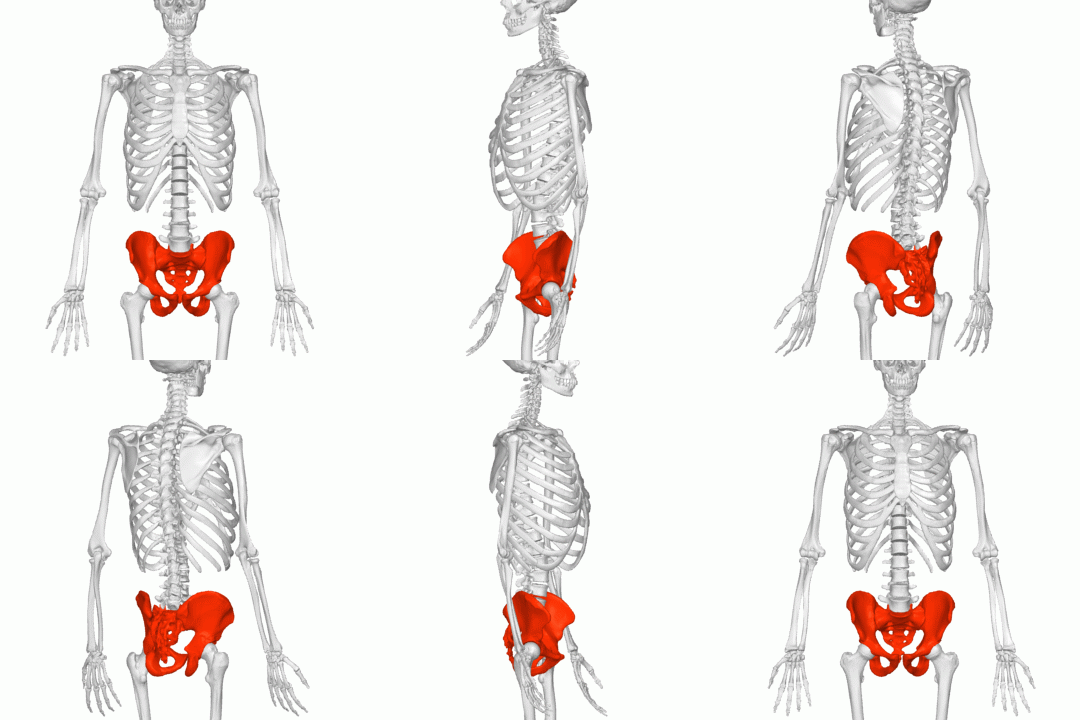
Hip Bone or Pelvic Girdle:The hip bone forms a large, basin shape framework at the lower end of the back bone, to which the legs are attached. The hip bone is also known as pelvic bone. It is made of number of bones fused together by fixed joints. The thigh bones of our legs are joined to the hip bone by ball and socket joints
                          

Bones of hands and legs: The upper limb of human body from the shoulder to the hand is called an arm. There are two arms in skeleton. The two arms are attached to the shoulder blades of the skeleton by ball and socket joints. Each arm consists of three parts. The upper arm, lower arm and hand. The upper is from shoulder to elbow. The upper arm consists of single bone called Humerus. The lower arm is from elbow to wrist. The lower arm is made up of two bones: radius and ulna. The upper arm bones connect to lower arm bones by hinge joint at the elbow. The hand consists of various small bones which form wrist, palm and fingers
                       
      
The lower limbs of the body on which person walks on stands are called legs. There are two legs in the human body. The two legs are attached to hip bone of skeleton by ball and socket joints. Each leg consists of three parts: upper leg, lower leg and foot. The upper leg is from hip to knee. The upper leg consists of single bone called femur or thigh bone. Wrist is made up of carpals. Palm is made up of metacarpals. Fingers are made up of phalanges. 
              
The lower leg is from knee to ankle. The lower leg consists of two bones: tibia and fibula. The upper leg bone connects to lower leg bones with hinge join. There is also a knee cap called patella. The foot consists of various small bones which form ankle, middle part of foot and toes. Ankle is made up of tarsals. Foot is made up of metatarsals. Toes are made up of phalanges. 
              
 Joints: The location where two or more bones meet is called a joint. Ligaments bind a bone to another bone. Tendons bind a bone to a muscle. 
Types of Joints 
Fixed joints: The joints where no movement of bones is possible are called fixed joint. The joints in the skull bone (cranium) are examples of fixed or immovable joints
           

Moveable joint: Movement is possible in these joints. Freely movable joints and partially movable joints. There are four types of movable joints in the body; which are as follows: 
Ball and socket joint: In this joint the rounded end of one bone fits into the cavity (hollow space) of another bone. It permits movement in all directions. The joints between shoulder and the upper arm is an example of ball and socket joint. Similarly, the joint between thigh and hip is an example of ball and socket joint. 
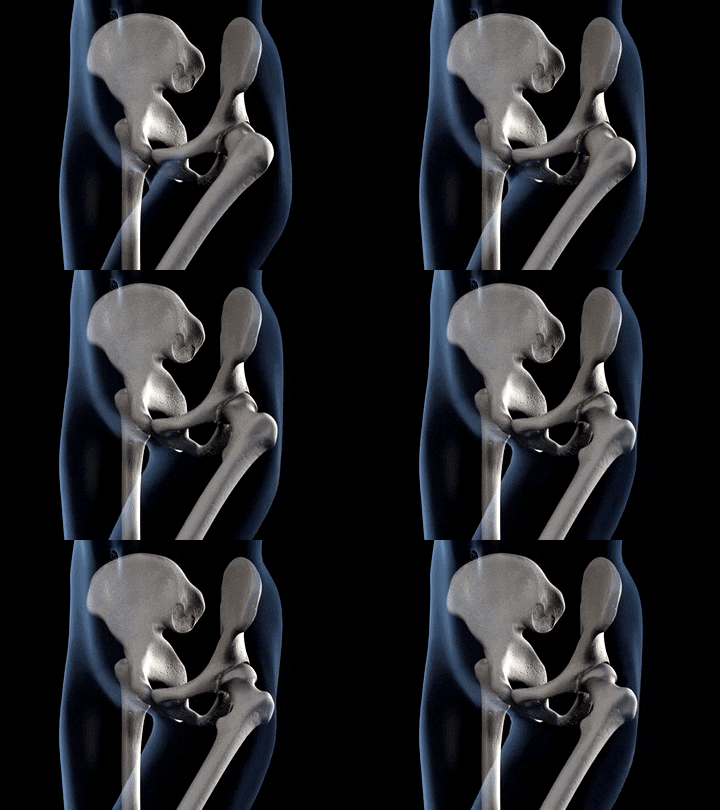
                

Pivot Joint: Pivotal joints allow for rotation, twisting, extension, and flexibility. This is the joint where our neck joints head and allow the movement of forward, backward, left and right direction. It is moreover like a cylindrical bone moving in a ring. Ex:Head & Arms
             

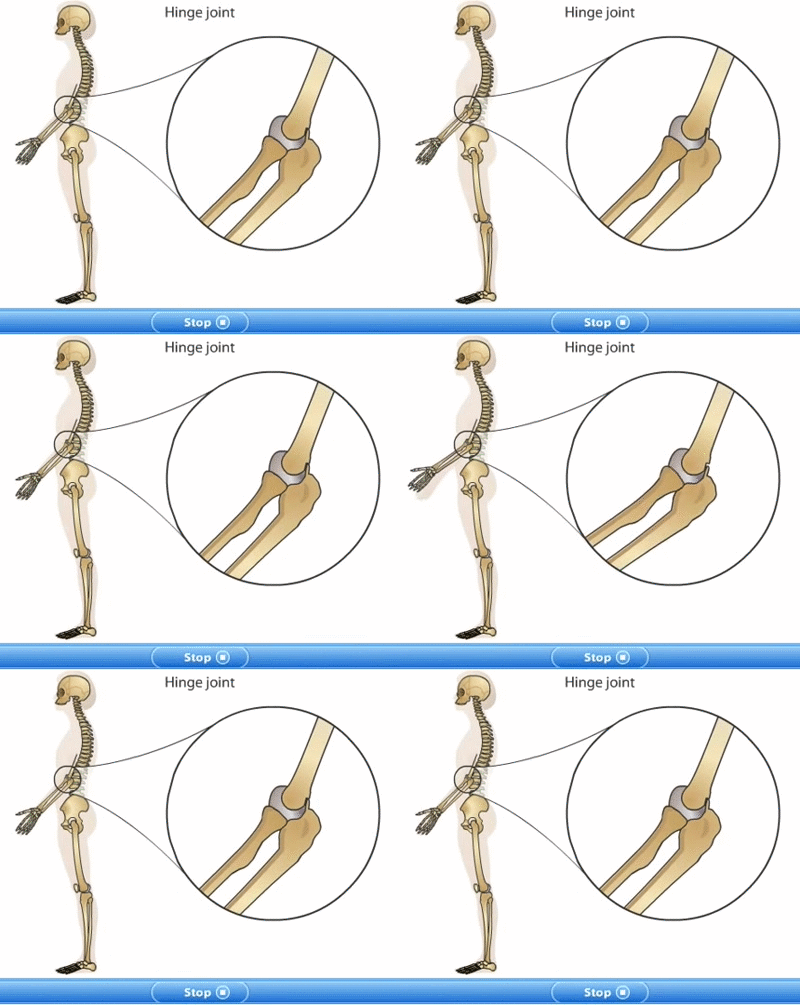
Hinge joint: Hinge joints are found between the two or more than two bones where we need back and forth movement. This joint is similar to the hinges in a door. This joint allows movement only in one plane and only up to 1800. The knee joint and elbow joint are examples of hinge joint. E.g. Elbows and Knees.. For example: knees, elbow, ankle joints. 

Gliding joints:
The movement in this joint happens due to sliding of bones over one another. Joints between the rings of the backbone are examples of gliding joint. The wrist joint is also an example of gliding joint. 
              

Muscles: Muscles are attached to the bones and is responsible for the movement of human body. There is change in the length of muscle due to contraction and relaxation. If you move your arm touching your shoulder you will observe the bulging part on your arm, this is muscle due to contraction and it come back to its normal position if you stretch your arm and muscle come to relax.


THANK YOU

TEXT: GETTING TO KNOW PLANTS CBSE CLASS-VII BIOLOGY


Go outside and observe all the plants around you Do you see that some plants are small, some very big, while some are just patches of green on the soil? Some have green leaves, while some others have reddish ones. Some have huge red flowers, some have tiny blue ones, while some have none. We do see a variety of plants existing all around us near our homes, in the school ground, on the way to the school, in the parks and gardens, isn’t it? Let us get to know the different parts of any plant. This will help us understand the differences between plants of different kinds. Can you label the stem, branch, root, leaf, flower and fruit of the plant. Colour the parts of the plant. 


Based on these characters most plants can be classified into three categories: herbs, shrubs and trees. Plants with green and tender stems are called herbs. They are usually short and may not have many branches. Herbs are small plants which have soft stem. Examples: Wheat, paddy, cabbage, grass, coriander, etc. 
                   

Shrubs: Some plants develop branches near the base of stem. The stem is hard but not very thick. Such plants are called shrubs. These are bushy and medium- sized plants and they are somewhat bigger than herbs. Their branches start from just above the ground. Examples: Lemon, Coriander, Henna, Rose, etc. 
                     

Tree: Some plants are very tall and have hard and thick stem. The stems have branches in the upper part, much above the ground. Such plants are called trees. These are tall and large plants with hard and woody stem. A single main-stem arises from the ground. The main-stem is called trunk. The trunk gives out many branches at certain height. The branches carry leaves, flowers and fruits. Examples: Mango, banyan, acacia, coconut, poplar, willow, etc. 
                    

Climber: Plants with weak stem that needs support is called climber. Examples: Grapevine, money-plant, cucumber, bean, etc. 
                       

Creepers: Plants with weak stem that cannot stand upright and spread on the ground are called creepers. Examples: Pumpkin, Watermelon, sweet potato, etc 
                      

Parts of Plant and their function:Plants are important part of nature. They can live on land and in water. Plants are very useful to us and we get many things from plant such as food, wood, paper etc. Most of our food that we eat comes from plants for example -fruits, vegetables, cereals, pulses etc. We eat roots, leaves, stems, flowers and fruits of plants. 
          

Each part of the plant has its own work to do. All these parts work together to keep the plant alive. There are two main parts of plant. One is shoot and the other is root.  The part of the plant that grows under the soil is called as root. Different plants have different types of roots
                   

The Shoot: The part of plant that grows above the soil is called the shoot. Stem, branches, leaves, flowers and fruits are all the parts of shoot
               

The function of each plant parts is described below. 
Root: The underground part of a plant is called root. It is usually pale in colour.  The root is a very important component of the plant system, as, without the presence of roots the plant ceases to exist. 
                 

Functions of Roots: Roots are responsible for absorbing minerals and water from the soil and transferring them to the stem. And the stem becomes capable of transporting these to all parts of the plant. Another important function of roots helps in holding the plant firmly to the soil. They anchor the plant to the soil. This is essential to support the upright position of the plants. Roots also perform the function of storing important nutrients and food for growth. 
                       

There are two major types of roots: Roots are two types: tap root and fibrous roots
Tap root: This is composed of a main root which grows from the base of the stem. Many branches and sub-branches come out of the main root (tap root). Examples: pea, radish, carrot, mango, marigold, mustard etc. 
                      

Fibrous root: In this type, a cluster of thin fibre-like roots arise from the base of the stem. These roots spread out in the soil. Examples: Maize, grass, wheat, millet, etc. 
                  

Aerial roots: These are roots of plants and trees that grow above the ground instead of under the ground. 
         

We have learnt that roots absorb water and minerals from the soil and the stem conducts these to leaves and other parts of the plant. The leaves prepare food. This food travels through the stem and is stored in different parts of plant. We eat some of these as roots— like carrot, radish, sweet potato, turnip and tapioca. We also eat many other parts of a plant where food is stored. 
                       

Stem: Stem usually grows above the ground. The stem makes the main structural framework of the plant. The stem bears leaves, branches, buds, flowers and fruits. 
                 

The point from where branches or leaves grow is called as node. The portion of a stem between two consecutive nodes is called the internodes
Functions of stem: 
The stem gives structural support to the plant. It bears branches, leaves, flowers and fruits. The stem carries water and minerals from the roots to different parts of the plant. Stem gets modified for food storage in some plants, e.g. potato, ginger, turmeric, etc. 
                           

Leaf: 
Observe the leaves of some plants around you. Are all the leaves of same size, shape and colour? How are leaves attached to the stem? The part of leaf by which it is attached to the stem is called petiole. The broad, green part of the leaf is called lamina. Can you identify these parts of the leaves in plants around you? Do all the leaves have petioles? names of some plants having reticulate and parallel venation.The leaves of plants are majorly responsible for performing two essential functions for the plant’s survival and growth. These two functions are called transpiration and photosynthesis. Leaves and stem together form the shoot. 
                       

Parts of a leaf: 
The leaf is a thin, flat and green structure which arises from the node of the stem. The green colour of leaves is due to the presence of chlorophyll. Chlorophyll is a green-coloured pigment. The flat green portion of the leaf is called leaf-blade or lamina. The leaf is attached to the stem by a short stalk; called petiole. Small lines present on a leaf are called its vein. These gives support and transport water and mineral through the leaf. A thick vein in the middle of the leaf is called midrib
                               

Let us discuss about: 
Venation: Arrangement of veins in a leaf is called venation. We distinguish between two major types of leaf venation. 
                           

Reticulate venation: When the veins make a network like structure, it is called reticulate venation,. This type of venation is seen in dicots like guava, mango, jackfruit, etc.
  

Parallel venation: When the veins run parallel to each other, it is called parallel venation.This type of venation is in monocots like banana, wheat, coconut, leaves of paddy, wheat, grass, etc. 
                            

Functions of leaf: 
Photosynthesis: Green leaves prepare food for plants by using water and carbon dioxide in the presence of sunlight. This process is called as photosynthesis. . Leaves prepare their food in the presence of sunlight and a green coloured substance present in them. For this, they also use water and carbon dioxide. Oxygen is given out in this process. The food prepared by leaves ultimately gets stored in different parts of plant. 
                             

Transpiration: Loss of water vapour from plants through the stomata is as called transpiration. Plants release a lot of water into the air through this process. A major portion of transpiration happens through stomata. 
                

Stomata: There are many small openings on the lower surface of a leaf. These are called stomata. Stomata allow gases to enter or exit the leaf. Unwanted water is also removed through stomata; in the form of water vapour
                          

Reproduction: Leaves of some plants helps in reproduction also. For e.g. leaves of Bryophyllum give rise to a new Bryophyllum plant. 

Children in next session we will learn about parts and function of the flower. 

FLOWER 
Which colour did you use for the flower ? Are all flowers colourful? Have you ever seen flowers on grass, wheat, maize, mango or guava? Are those brightly coloured? Let us study a few flowers. 
             

 Flower: Flower is the most beautiful and colourful part of a flowering plant. It is the reproductive part of a plant. Following are the main parts of a flower: 


Sepal: The outer green leafy structure in a flower is called sepal. Petals make the first whorl of a flower. This whorl is called calyx. It protects the flower at bud stage. Different flowers have petals of different colours. 
                       

Petals: The coloured leaf-like structures; next to the sepals; are called petals. The bright colours of the petals, attracts insects. This helps the plants in reproduction. The whorl formed by the petals is called corolla. 
                          

Stamens: Around the centre of the flower there are many little stalks with swollen tops. These are called Stamen. It is the male part of the flower. Each stamen consists of a green stalk called filament. The capsule-like structure; called anther is at the top of the stamen. The anther produces pollen grains. Pollen grains are powder like particles and take part in reproduction.      
  
Pistil: It is the female part of the flower. It is a flask- shaped structure in the middle of the flower. It is divided into three parts.   


Ovary: The lower broader portion of the pistil is called ovary. It contains the ovules which take part in reproduction. 
Style: The narrow middle portion of the pistil is called style. 
Stigma: The sticky end at the top of the style is called stigma.
                          

Fruits are the fleshy substances that usually surround seeds. Some of the fruits that we eat are orange, mango, apple, grapes, etc. They protect the seeds and attract animals to eat them. This helps in seed dispersal. ` 
                     

Seeds contain plant material that can develop into another plant. This plant material is called an embryo. Seeds are covered with a protective seed coat and have one or two cotyledons. Cotyledons are the food for the baby plant until it can make its own food from light and are often the first embryonic leaves of the plant. 
The number of sepals, petals, stamens and pistils may also be different in different flowers. Some of these parts may even be absent at times! We have studied some features and functions of leaves, stems and roots. We studied the structure of different flowers. We will learn about the function of flowers in higher classes. We will also learn about fruits in higher classes.
THANK YOU

Monday, January 4, 2021

PPT: HUMAN CIRCULATORY SYSTEM CHAPTER 8 - CBSE BIOLOGY CLASS-VII